Sniff Test to Spreadsheet: Auditing Your Stable's Air Around a Hemp Switch
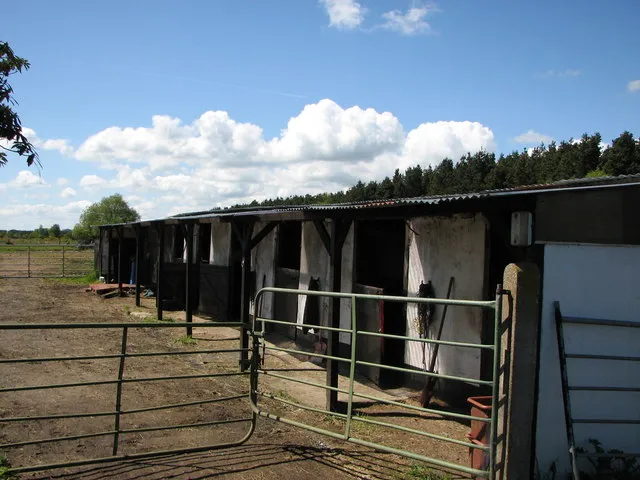
Photo: Willie Duffin, CC BY-SA 2.0, via Wikimedia Commons
There's a moment, usually around February, when you walk into the yard and something hits the back of your throat before you've even found the light switch. You blame the bedding. It might well be the bedding. But it might equally be the roof, the blocked ridge vent, the four horses sharing one doorway, or the fact that nobody has lifted a wet patch since Bonfire Night. If you're going to spend more on hemp, it's worth knowing what you're actually buying.
Why measuring beats sniffing
The human nose is a poor instrument. It adapts within minutes — walk into a slightly whiffy stable and you'll stop noticing the ammonia long before your horse does. Horses, meanwhile, have their noses roughly where the ammonia is, all night, every night. The link between poor stable air and airway disease is well established: recurrent airway obstruction (what we still call heaves), inflammatory airway disease, coughing, nasal discharge and reduced exercise tolerance are all made worse by ammonia, dust and spores in the breathing zone.
The useful thing about measuring is that it separates the variables. If you record the numbers for three mornings before you change bedding, then again a fortnight and a month after, you'll know whether that £9-a-bale hemp was money well spent or whether you've simply bought a nicer-looking bed.
Start with a proper baseline
Three consecutive mornings, same time, before anyone mucks out or turns out. Ideally pick a still, cold, damp spell — that's when air quality is at its worst and differences show up most clearly. Don't bother measuring on a windy Tuesday when every door is propped open; you'll get lovely numbers that mean nothing.
Record a few basics alongside the air readings: number of horses stabled, bedding type and depth, when the bed was last fully skipped out, whether hay is fed from the floor, and the outside temperature. Without context, a number is just a number.
The toolkit that actually works
You don't need a laboratory.
- An ammonia meter. A handheld electrochemical detector with a resolution of 1 ppm is the single most useful purchase, usually somewhere between £60 and £150. Colour-change detector tubes work too and are used in agriculture widely, but they're consumable and fiddly.
- A humidity and temperature logger. Cheap, cheerful, and surprisingly revealing. Consistently high relative humidity in a stable suggests you're trapping moisture — urine, breath and wet bedding all contribute.
- A torch. Not a joke. In a darkened stable, shine a torch beam across the air at horse head height and you'll see the dust load in the beam. Do it before mucking out and again afterwards. It's crude, but it's repeatable and it costs nothing.
- A simple notebook or phone note. The discipline of writing it down is worth more than any gadget.
If you want to go further, an anemometer held at doorways and vents gives you an idea of air movement, and a CO2 monitor can act as a rough proxy for how well a stable is ventilated — high CO2 generally means the air isn't changing over.
Where to put the probe
Head height. Not knee height, not up by the rafters. For a 15hh horse at rest that's roughly 1.2 to 1.5 metres from the floor, and ideally in the corner where the horse actually stands, not in the middle of the doorway. Take three readings a minute apart and use the middle one; sensors take a moment to settle.
Worth measuring in more than one stable if you have them. It's common to find that one box is materially worse than the rest, which usually points to a building issue rather than a bedding one.
What the numbers mean
There's no legal limit for ammonia in a stable, which is part of why this gets ignored. The working figures that vets and barn designers tend to quote are these:
| Ammonia at head height | What it suggests |
|---|---|
| Under 5 ppm | Good — bedding and ventilation are doing their job |
| 5–10 ppm | Acceptable but improvable; check muck-out routine |
| 10–20 ppm | Irritant to airways; act on it |
| Over 20 ppm | Poor; likely to be affecting respiratory health |
Treat those as guides rather than gospel. A horse with existing airway disease is more sensitive than a fit youngster, and short spikes when you muck out matter too — that's when dust and ammonia are thrown into the air and inhaled.
What a vet would look at
If your horse is coughing, has a nasal discharge, breathes with a noticeable effort at rest, or has gone flat in work, air quality is one piece of a bigger picture. A vet examining for airway disease will be interested in respiratory rate and effort, auscultation, whether there's a cough on tracheal squeeze, and often endoscopy to grade mucus and look at the trachea. In more involved cases they'll take a bronchoalveolar lavage or tracheal wash.
That's the point where measuring your stable becomes genuinely useful, because you can hand over real data rather than "it does smell a bit". It also means you're not expecting bedding to fix something that needs veterinary input. No bedding — hemp included — treats heaves.
Where hemp genuinely earns its keep
Hemp hurd is absorbent, and absorbency is directly relevant to ammonia: less free urine sitting in the bed means less substrate converting to ammonia gas. Hemp also tends to be low in dust compared with some straw and with poor-quality shavings, and it compacts into a reasonably stable mat that doesn't get kicked about as much.
But hemp is not magic. A deep litter bed that hasn't been dug out since October will still reek, whatever it's made of. Bales vary between suppliers and between batches — some hemp bedding arrives with a noticeable fraction of fine, dusty material, so check before you commit to a pallet. And nothing beats air movement: a well-ventilated stable with a straw bed can out-perform a sealed box with the most expensive hemp on the market.
A simple before-and-after protocol
- Three baseline mornings, same time, before mucking out. Ammonia at head height, humidity, temperature, torch-in-the-beam dust check.
- Note your routine: how often the bed is fully skipped, whether wet patches come out daily, where hay is fed from.
- Switch bedding on one stable only. Leave the rest alone as a control — this is where most yard trials fall down.
- Re-measure at 7 days, 21 days and 6 weeks. Keep the same time of day and the same weather conditions where you can.
- Change only one thing at a time if possible, otherwise you'll never know what worked.
If the numbers don't move
Then you've learned something worth knowing. Common culprits: muck-out frequency, wet patches left in, hay fed from the floor in a deep bed, blocked or absent roof ventilation, gutters draining into the stable, or simply too many horses in too small a building. Fix the air first. Then decide whether to spend the extra on bedding — or whether the shavings were never the villain in the first place.